First 30 Days With Your EV

A step-by-step first-month plan for charging, settings, tire care, route confidence, cleaning, storage, and smart accessory decisions.

Best for
New EV owners
Vehicles
Tesla Model 3, Tesla Model Y, EV-generic
Reviewed
2026-06-26

Printable artifact

First 30 days checklist PDF

One printable page for charging habits, safety checks, apps, and what can wait. Instant download — no email.

  • Instant PDF download
  • No email required
  • Print or save offline
Download first 30 days PDF
First 30 days checklist PDF preview
Real PDF page · tap to open

What to do first

The first month should reduce friction, not fill the car with accessories. Focus on charging confidence, basic protection, tire care, app setup, and one public-charging rehearsal. Buy slowly after the car shows you what you actually need.

Day 1: make the car usable

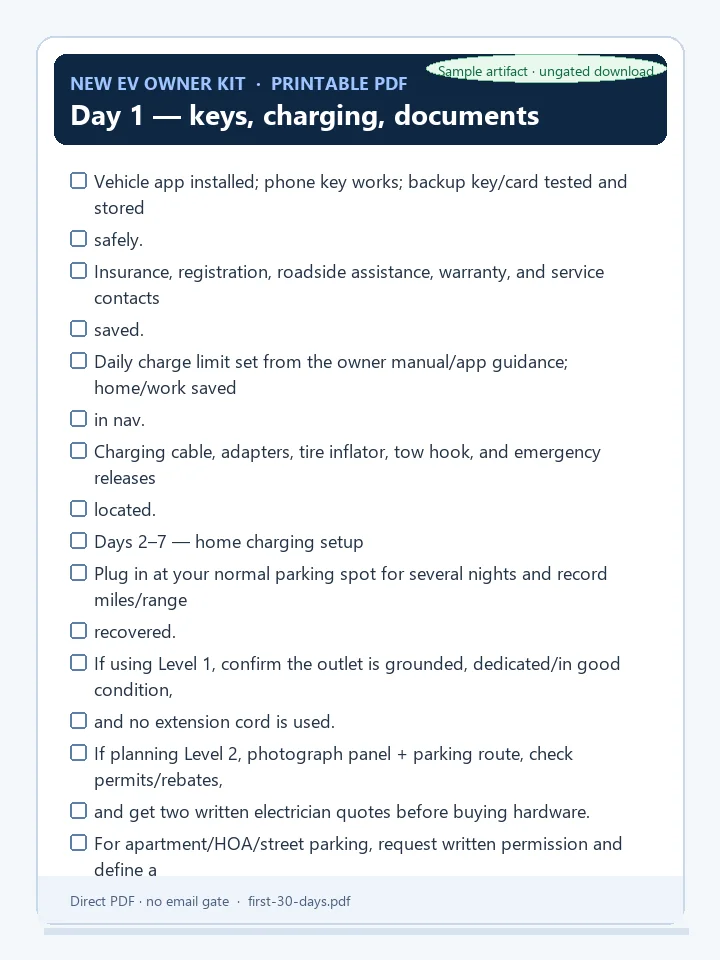
  • Set up the vehicle app and confirm phone key, backup key card, or physical key access.
  • Save roadside assistance, insurance, registration, and service contact details.
  • Set the daily charge limit according to your vehicle and battery guidance.
  • Add home, work, and frequent destinations to navigation so route estimates are familiar.
  • Check tire pressures when the tires are cold.
  • Remove delivery packaging and inspect the cargo area, charging cable, and underfloor storage.

Do not spend the first day installing every accessory. Learn the baseline first.

Days 2-7: build your daily routine

By the end of week one, you should know how the car fits your normal life.

Charging:

  • Plug in at your normal parking location for several nights.
  • Note how much range you recover overnight.
  • Install local public-charging apps and add payment methods.
  • Try one public charger while you still have plenty of range.

Comfort and settings:

  • Adjust seat, mirrors, steering, charge limit, lock behavior, climate preconditioning, app alerts, and driver profiles.
  • Learn the windshield wiper, defrost, charge-port, and emergency door-release controls.
  • Set a tire-pressure reminder if your vehicle or app does not do this clearly.

Protection:

  • Add floor or cargo protection if you live with mud, snow, kids, pets, sports gear, or gravel lots.
  • Keep a small microfiber towel and screen-safe cloth in the car.
  • Delay trim pieces, novelty lighting, and decorative covers.

Week 2: run a small road-trip rehearsal

Take a short drive that requires either a public charger stop or a route-planning check. The point is not distance. The point is removing uncertainty before a real trip.

Practice:

  • Navigating to a charger from the car’s system.
  • Verifying charger status in the charging network app.
  • Parking close enough for the cable.
  • Starting and stopping a session.
  • Reading charging speed, cost, and estimated departure range.

Pack only a small road-trip kit: tire inflator, charging cable if applicable, microfiber towel, trash bags, hand wipes, and a simple organizer.

Weeks 3-4: buy from evidence

Now look at what actually bothered you.

If groceries slide around, add storage. If the cabin gets dusty, build a small cleaning kit. If kids or pets ride often, prioritize washable protection and restraint compatibility. If the car already feels easy to use, do not buy anything just because another owner posted it.

Common mistakes

Mistake: buying a full accessory bundle before delivery

Bundles often include duplicate organizers, niche trays, and trim pieces that do not match your routine. Buy basics first, then fill gaps.

Mistake: ignoring tires

EVs are heavy and tire pressure matters for efficiency, comfort, and safety. Check pressures cold and learn the recommended value for your vehicle.

Mistake: waiting until a trip to try fast charging

Do one low-stress charger test in week two. It will teach more than ten videos.

Need now, wait, skip

Need now:

  • A proven charging routine.
  • App setup and backup access method.
  • Floor or cargo protection if your use case is messy.
  • Tire-pressure check and a reliable way to add air.
  • A small cleaning setup for glass, screens, and spills.

Wait:

  • Console trays and specialty organizers.
  • Extra adapters.
  • Appearance upgrades.
  • Roof racks or cargo boxes unless a specific trip requires them.

Skip:

  • Decorative trim that blocks access or creates rattles.
  • Cheap electrical accessories with unclear ratings.
  • Duplicate emergency kits that expire unnoticed.

Printable 30-day checklist

  • Day 1: app, keys, insurance, charge limit, tire pressure, charging cable location.
  • Week 1: home charging test, public charging apps, basic protection, cleaning cloth.
  • Week 2: local public-charger rehearsal, tire inflator check, route-planning test.
  • Week 3: storage decisions based on groceries, work gear, kid gear, or pet gear.
  • Week 4: review what you used, return what you did not, and make a short buy/wait/skip list.

Start with EV settings to change first, charging basics, and the range anxiety reality check, then use home charger installation if you need an outlet or Level 2 plan. Add the charger apps directory before your first public session, build the EV emergency kit checklist, set up the seasonal EV maintenance calendar for monthly tire, wiper, charging-cable, brake, and winter reminders, and read accessories to skip before buying anything cosmetic.

Planner generator

Build your first-30-days checklist

Choose the setup closest to your situation. The checklist updates into a printable day-one, week-one, route-test, and day-30 plan.

Charging setup
Household
Driving pattern
Weather

First 30 days: home charging setup + mixed driving

A printable first-month checklist that starts with charging confidence, then adds family, weather, and trip-specific setup only when it earns space.

Day 1

Make the car usable before buying extras

  • Photograph delivery condition, tire pressures, adapters, and included charging cables.
  • Schedule a licensed electrician or landlord-approved outlet check before buying charging accessories.
  • Save roadside assistance, insurance, registration, and service-contact details in the phone.
Week 1

Build the daily routine

  • Use Level 1 or public charging for one week before deciding whether a Level 2 install is necessary.
  • Set up the cabin basics: floor protection, glass cloth, screen cloth, and a small trash solution.
  • Check tire pressure cold twice this week so the normal range is familiar.
  • Keep the cabin setup minimal until a real storage problem repeats twice.
  • Keep one glass cloth, one interior cloth, and a small spill kit in the car.
Weeks 2–3

Rehearse the edge cases

  • Try one longer errand loop with a planned public charging stop, even if you do not need the energy.
  • Practice opening the charge port, routing the cable, and ending a charge session when nobody is waiting behind you.
  • Move rarely used gear out of the cabin and keep only safety, charging, and cleanup basics in reach.
Day 30

Buy from evidence, not new-car excitement

  • Review what was actually annoying after three weeks before buying organizers or cosmetic accessories.
  • Create a repeatable monthly check: tires, washer fluid, charging apps, cables, and emergency kit.
  • Use the skip list before adding duplicate cables, trim pieces, or single-purpose gadgets.
Buy now
  • floor protection
  • portable tire inflator
  • glass and screen cleaning cloths
  • small emergency pouch
Wait
  • specialty organizers until daily annoyances repeat
  • screen protectors until glare or fingerprints bother you
  • extra adapters until the charging pattern is proven
Skip
  • duplicate charging cables before the real charging routine is known
  • novelty trim pieces
  • single-purpose gadgets that do not solve a weekly problem

Printable artifact

First 30 days checklist PDF

One printable page for charging habits, safety checks, apps, and what can wait. Instant download — no email.

  • Instant PDF download
  • No email required
  • Print or save offline
Download first 30 days PDF
First 30 days checklist PDF preview
Real PDF page · tap to open

Referenced picks

Verdict: Wait

floor-mats

Vehicle-specific all-weather floor mats (after you pick the car)

WeatherTech / TuxMat / Husky (research) · mid · research-backed pick

Why: Wait until after you pick your vehicle and trim year. Search WeatherTech, TuxMat, or Husky for exact model-year fit — do not treat a single universal ASIN as a Week-1 Buy.

Who should skip: Skip early shopping if the car is not final or if OEM all-weather mats already fit vents and fasteners correctly.

Risk notes: Poor-fit mats can interfere with pedals. Confirm model year and fastener compatibility before any purchase. No Week-1 commerce CTA.

Fit: EV-generic, Tesla Model Y

Verdict: Buy

tire-care

Fanttik X8 APEX portable tire inflator

Amazon · mid · owner-popular option

Why: Week-1 Buy: cordless Fanttik X8 APEX makes delivery-week and road-trip tire pressure top-ups practical without hunting for a station air hose.

Who should skip: Skip if you already own a reliable cordless inflator and know your door-sticker PSI targets.

Risk notes: Use the vehicle door-jamb placard for cold tire pressure. Do not overinflate. Recheck after long highway runs.

Fit: EV-generic, Tesla Model 3, Tesla Model Y

Affiliate link — we may earn a commission. Disclosure

View on Amazon

Next in setup spine

Build your first-month plan

Answer a few practical questions and get a week-by-week path tied to your charging and commute.

Open planner