What to do first
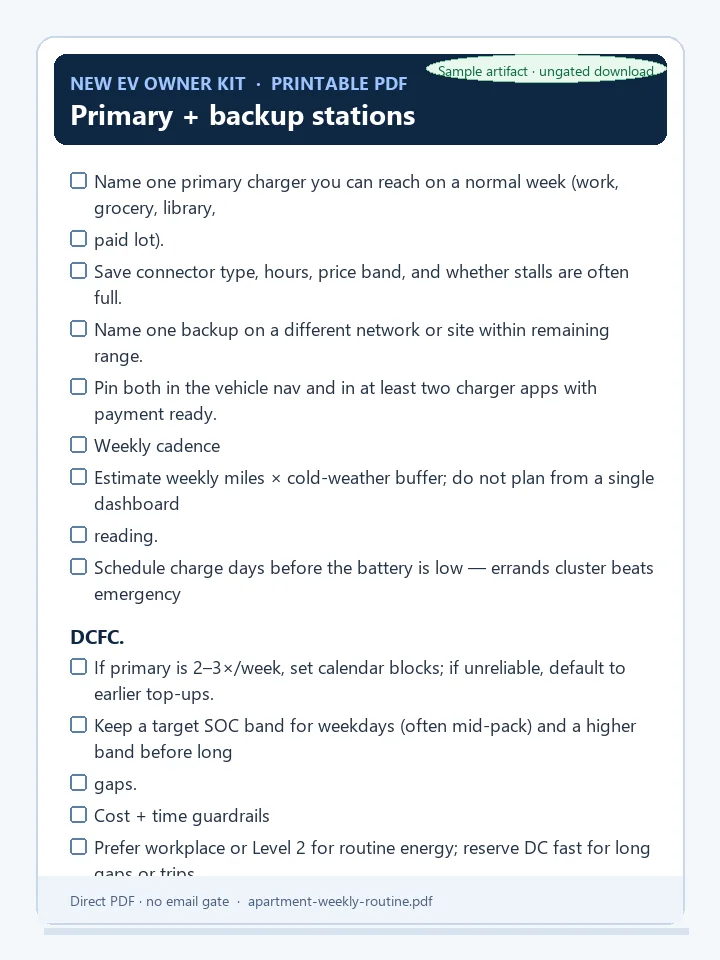
Owning an EV without a private garage can work, but it has to be treated like a routine, not a hope. The goal is to replace “I will find a charger when I need one” with a weekly plan that has a primary charger, a backup charger, and a bad-weather option.
Start here before you buy accessories or sign a lease around a charger promise:
- Map the chargers within your real week: home, work, grocery, gym, school, and two routes you drive often.
- Separate Level 2 dwell charging from DC fast charging. Level 2 is for parked time; DC fast charging is for quick recovery and backup.
- Install the two or three network apps that actually cover those locations, add payment, and complete one test session before the battery is low.
- Ask your workplace, landlord, condo board, or HOA about charging permission in writing.
- Build a weekly charging appointment and a backup plan before you rely on the car for a commute.
The no-home-charging reality check
Public charging can be perfectly livable when one of these is true:
- You have reliable workplace charging several days per week.
- You can park for two to four hours at a nearby Level 2 charger while doing something you already do.
- You have dependable DC fast charging close to home and your schedule can absorb the stop.
- Your weekly mileage is modest enough that one planned session plus one backup session covers the week.
It becomes stressful when charging requires a special trip every few days, your nearest chargers are frequently broken or occupied, winter range loss is significant, or your schedule cannot tolerate a 30- to 60-minute detour.
Fast comparison: public, workplace, or landlord/building path
| Path | Best fit | What to test first | Main risk | Good first action |
|---|---|---|---|---|
| Workplace Level 2 | You park at work for several hours multiple days per week | Charger access rules, price, availability at your arrival time, and whether overnight/idle fees apply | Policy changes, full stalls, or access limited to certain employees | Ask facilities/HR for written rules and complete one normal workday session |
| Destination/public Level 2 | You can charge while doing groceries, gym, school, library, or appointments | Real delivered speed, parking fees, safety, app reliability, and stall turnover | Slow sessions become separate errands if they do not overlap with life | Pick two locations on different networks and test both before relying on one |
| Public DC fast charging | You need quick recovery or have no useful Level 2 dwell time | Connector compatibility, price, peak-time queues, charging curve, and nearby safe waiting area | Higher cost, congestion, and more battery/routine stress if used for every fill | Schedule it like a weekly appointment and keep a second DC site in reserve |
| Landlord/HOA/shared building charging | You have assigned parking or a board willing to evaluate infrastructure | Permission process, permit requirements, billing, load capacity, rebates, and right-to-charge rules | Verbal promises turn into delays, unpermitted work, or unfair billing | Send a written, safety-focused request before buying equipment |
| Approved portable/outlet charging | A specific outlet is allowed, grounded, weather-appropriate, and circuit-reviewed | Heat at plug/outlet, breaker trips, GFCI behavior, cable path, and owner permission | Unsafe cords, damaged outlets, trip hazards, or informal electricity use | Treat any questionable outlet as an electrical project, not a charging plan |
Choose one primary path and one backup path. A no-home-charging plan that depends on a single stall is not a plan yet.
Build your weekly charging routine
Use this simple pattern for the first month:
1. Set a weekly target
Estimate your normal weekly driving miles, then add a buffer for weather, errands, and unexpected trips. If you drive 180 miles per week, plan for roughly 220 to 250 miles of usable range. Do not wait until the car is nearly empty; public charging is easier when you are topping up from “comfortable” to “ready,” not rescuing a low battery.
2. Pick a primary charger type
Workplace Level 2: Best if you can plug in for a full work block. Treat it like your “home base” and keep a second public option nearby.
Destination Level 2: Best when it overlaps with a grocery store, gym, library, campus, or regular appointment. It is slower, but the time cost is low if the car charges while you are already parked.
DC fast charging: Best for quick recovery, road trips, and backup. It is convenient, but it is usually more expensive than residential electricity and can be busier at peak times.
3. Schedule two charging windows
Put one normal charging window and one backup window on your calendar. Example:
- Tuesday evening: Level 2 at grocery/library for 90–150 minutes.
- Friday lunch or commute: DC fast charge to restore weekend buffer.
If the first session fails, the backup window prevents a bad week from becoming an emergency.
4. Do a one-week shakedown
For one week, behave as if home charging does not exist even if you have a temporary outlet. Track:
- station availability,
- speed delivered,
- cost per session,
- time spent out of your way,
- idle fees, parking fees, or garage fees,
- whether you felt rushed, unsafe, or stranded.
If the shakedown feels annoying but manageable, the plan may work. If it disrupts sleep, work, childcare, or medication/medical travel, treat no-home-charging as a serious fit problem.
Cost expectations
No-home-charging owners often pay more than owners with a home outlet or time-of-use utility plan. Public pricing varies by network, location, membership, session fee, idle fee, parking fee, and whether billing is per kWh or by time where allowed.
A practical way to estimate cost:
- Open your local charger apps and record the exact price at your likely stations.
- Estimate monthly energy use from your driving: miles per month divided by your car’s miles per kWh.
- Multiply by the public charging price, then add memberships, parking, and occasional faster-but-pricier backup sessions.
- Compare that with your prior gasoline spend and with any workplace or utility incentives.
For a faster first pass, open the Charging Cost Calculator and set the public-charging share to match your real routine. Frequent DC fast charging can look very different from mostly home or workplace Level 2 charging.
Do not assume every public charger is cheap. A workplace or apartment Level 2 rate can be a bargain; frequent DC fast charging may erase much of the fuel-cost advantage.
Landlord, HOA, and condo-board ask
Keep the request practical and low-drama. Your landlord or board is usually worried about cost, liability, installation mess, reserved parking, billing, fire/electrical safety, and fairness to other residents.
Send a short written request with:
- your parking space number and whether it is assigned, deeded, leased, or shared,
- the charger type you are requesting: shared Level 2, assigned-space Level 2, outlet evaluation, or permission to use an existing outlet,
- a commitment that all electrical work must be permitted, code-compliant, and performed by a licensed electrician where required,
- a plan for cost responsibility: you pay, shared building amenity, utility rebate, or networked billing,
- a note that many states, cities, utilities, and air districts have EV charging incentives or “right-to-charge” rules, but the details are local and must be verified,
- a request for the building to ask its utility about EV infrastructure programs and load-management options.
Copy-and-paste request
I am considering/own an electric vehicle and would like to discuss safe, code-compliant charging at my assigned parking space or through a shared building charger. I am not asking to run an extension cord or use unapproved equipment. Could the building review options for a permitted Level 2 charger, a utility incentive, or a networked shared charger with billing? I am happy to provide vehicle charging requirements, meet with a licensed electrician, and follow any reasonable rules for insurance, access, and cost recovery.
What to avoid asking for
- Permission to run an extension cord across a sidewalk, hallway, garage aisle, or landscaping.
- Informal use of a random outlet without approval, circuit review, billing agreement, and weather rating.
- A charger install with no permit or electrical load review.
- A promise that the building will “figure it out later” after you buy the car.
Portable charging safety
Portable charging can be useful, but it is not a workaround for unsafe infrastructure.
Follow these rules:
- Use the vehicle manufacturer’s mobile connector or safety-certified EV charging equipment.
- Plug only into an outlet that is in good condition, grounded, properly rated, and allowed by the property owner.
- Do not use ordinary household extension cords for EV charging.
- Do not pinch a cable under a garage door, drape it across a walkway, or leave a connector in standing water.
- Use outdoor-rated equipment for outdoor charging.
- Stop if the plug, outlet, adapter, or breaker gets hot, smells, discolors, trips repeatedly, or shows damage.
- Do not use unknown-brand adapters or “dryer outlet” workarounds unless the exact setup is allowed by your vehicle and charging-equipment manufacturer and reviewed for the circuit.
If you only have a questionable outlet, you do not have home charging yet. You have an electrical project.
Backup plans that actually help
Create backups before you need them:
- Save at least two nearby chargers in different networks.
- Keep payment active in each network app and carry a physical card that can be tapped where supported.
- Know one 24-hour charger on your side of town.
- Know one charger near a safe waiting place: grocery store, hotel lobby, transit center, campus, or well-lit retail area.
- Keep enough battery to reach a second charger if the first is down.
- Check recent station status before leaving, especially in cold weather or on holiday weekends.
- If your car supports route planning with charger preconditioning, use it before DC fast charging.
When no-home-charging is a bad fit
Be honest. An EV may not be the right primary vehicle yet if several of these are true:
- You drive high mileage every weekday and cannot charge at work.
- The nearest reliable charger is far enough away that charging becomes a separate errand.
- Local public chargers are regularly broken, blocked, expensive, or in locations where you do not feel safe waiting.
- You live in a very cold climate and cannot add charging time or buffer during winter.
- You cannot charge during predictable windows because of shift work, caregiving, disability access needs, or shared-vehicle logistics.
- You need the vehicle for emergency response or medical travel and cannot maintain a comfortable reserve.
- You are buying the EV mainly because a building, seller, or dealership casually promised charging “soon.”
In those cases, consider waiting, choosing a plug-in hybrid, choosing a shorter lease, negotiating workplace charging first, or moving only after charging access is confirmed in writing.
First-month checklist
- Primary charger tested.
- Backup charger tested.
- Payment methods added in all needed apps.
- One weekly charging window on the calendar.
- One backup window on the calendar.
- Workplace, landlord, HOA, or condo-board request sent in writing.
- Utility/rebate search completed for your address or building.
- Portable charging equipment inspected for manufacturer approval, weather rating, and outlet safety.
- Winter/rain/late-night charging backup identified.
- One “this is not working” threshold defined before ownership gets miserable.
Need now, wait, skip
Need now:
- Two tested charging locations on different networks or sites.
- Charger apps with payment already configured.
- A written charging request for work, apartment, condo, or HOA parking.
- A weekly routine with a reserve buffer.
Wait:
- Paid network memberships until your actual sessions prove they save money.
- Portable adapters until you know the exact outlet, amperage, and manufacturer compatibility.
- Expensive trunk gear until the charging routine is stable.
Skip:
- Extension-cord charging.
- Unapproved outlet sharing.
- Buying an EV on the assumption that your building will install charging soon.
- Depending on one public charger with no backup.
Sources and further reading
- U.S. Department of Energy AFDC: Charging Electric Vehicles at Home, including Level 1/Level 2 guidance, certified equipment, permitting, and multifamily considerations.
- U.S. Department of Energy AFDC: Charging Electric Vehicles in Public, including Level 2, DC fast charging, workplace/public siting, and community infrastructure planning.
- U.S. Department of Energy AFDC: Electric Vehicle Charging Station Locations for the national station locator.
- U.S. Department of Energy AFDC: Federal and State Laws and Incentives search for state, local, utility, and right-to-charge/incentive research.
- ENERGY STAR: EV Chargers, including Level 1 and Level 2 range-per-hour estimates, certified charger safety testing, and no-overnight-charging alternatives.
- IRS: Alternative Fuel Vehicle Refueling Property Credit, for federal tax-credit eligibility that may apply to some charging-property installations.
- Electrify America: Mobile App for examples of public-network app, payment, charger availability, connector, notification, and session-history features.
Related guides
Start with home and public charging basics, estimate your monthly spend with the Charging Cost Calculator, then set up your charger apps and read public charging etiquette. If you may eventually get building charging, review home charger installation before talking to an electrician. Keep trickle charging and error codes and the road-trip kit handy for backups.