What to do first
A used EV still has many of the same systems as a gasoline car, but the battery, charging equipment, and software history deserve extra attention. Start with the vehicle history report, ownership records, and a list of what you want to test before the inspection. Do not rely on the dashboard alone.
Before the inspection:
- Ask for the full vehicle history report.
- Confirm warranty status, state of charge at delivery, and service records.
- Request the original charging cable or mobile connector if it was included.
- Check whether there are open recalls or service campaigns.
- Plan a test route that includes highway, local, and parking maneuvers.
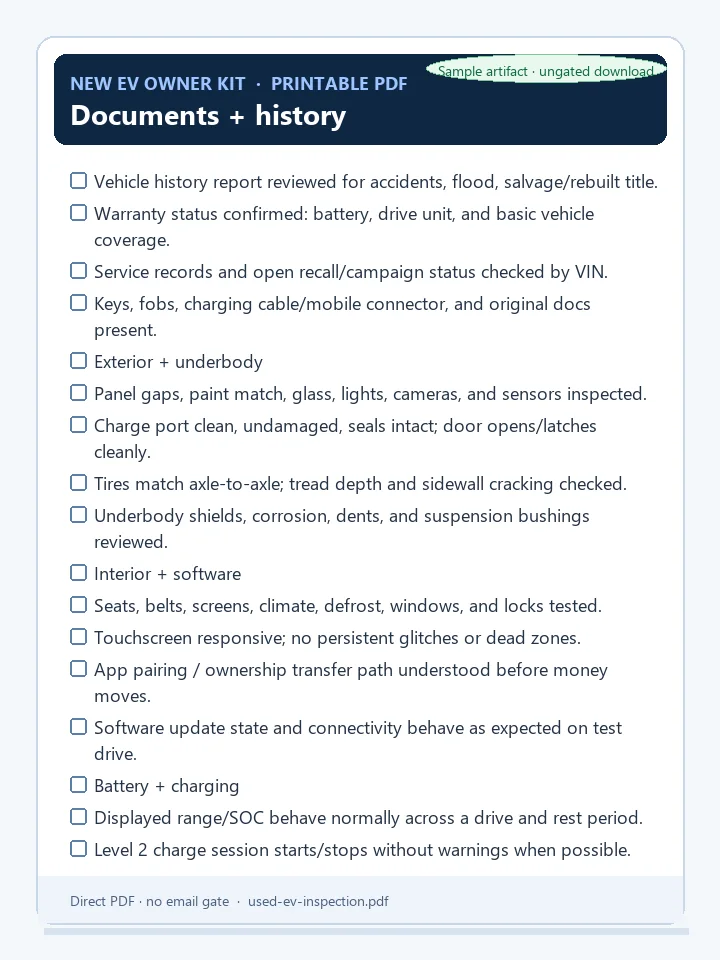
Before you buy: documentation and history
- Vehicle history report reviewed for accidents, flood, and title issues.
- Warranty status confirmed: battery, drive unit, and vehicle.
- Service records reviewed for recurring concerns.
- Recall and campaign status checked by VIN.
- Original documentation and keys present.
- Mobile connector or charging cable accounted for.
- Vehicle not reported as salvaged or rebuilt.
Physical inspection checklist
Exterior:
- Body panels aligned and free of mismatched paint.
- Glass and lights intact; no clouded headlights or cracked screens.
- Charge port clean, undamaged, and sealed.
- Tires match on both axles; inspect tread depth and sidewall cracking.
- Underbody free of major dents, corrosion, or broken shields.
- Suspension components free of bushings that are cracked or worn.
Interior:
- Seats and seatbelts operational with no tears or excessive wear.
- Touchscreen responsive; no dead pixels or persistent glitches.
- Climate, defrost, wipers, and windows tested.
- Steering, brakes, and pedal operation smooth.
- Doors, trunk, and charge port open and close without binding.
Battery and charging health
- State of charge and estimated range displayed normally.
- One full charge completed during your test period if possible.
- Charge rate on a Level 2 session consistent with expectations.
- No warnings during charging start, session, or stop.
- Preconditioning or scheduled charging functions checked if available.
- Battery thermal management sounds normal; no unusual pump or fan noise.
- Warranty capacity threshold, state-of-health report, or diagnostic scan reviewed when available.
Tip: A large range drop during the drive or charge is more meaningful than a single dashboard readout. For the deeper battery-specific process, use the used EV battery health deep dive.
Test drive checklist
- Acceleration and regenerative braking feel normal.
- No unusual steering, suspension, or braking noise.
- Navigation and connectivity behave as expected.
- Software updates install or pause as expected.
- Cabin temperature control reaches target quickly.
Common mistakes
Mistake: trusting only the dashboard
Battery health and range estimates can vary by temperature, recent driving style, and calibration. Confirm with a charge test and repeated observations.
Mistake: skipping tire and brake inspection
EVs use regenerative braking, but the friction brakes still exist and tires still wear unevenly under weight and torque.
Mistake: ignoring warning lights or unusual noises
Unusual pump, fan, or suspension sound can become expensive repairs. Ask for records or get a second opinion.
Need now, wait, skip
Need now:
- History report, warranty status, and service records.
- Charge-port and cable inspection.
- Tire and brake check.
- Test drive that includes local roads, parking, and highway.
- Warranty confirmation before paying.
Wait:
- Immediate accessory purchases until you know the fitment, trim, and existing condition.
- Cosmetic fixes before you know whether the vehicle passes your checks.
- Extensions or complex adapters until you know your charging access.
Skip:
- Vehicles with salvaged or rebuilt titles if the price is not steeply discounted.
- Deals that pressure you to skip an independent inspection.
- Accessories that block access to the charge port or repairs.
Printable inspection checklist
Before the visit:
- History report requested.
- Warranty status confirmed.
- Recalls checked by VIN.
- Test route planned.
On site:
- Body, glass, lights, charge port checked.
- Underbody and suspension inspected.
- Interior, screen, climate controls tested.
- Battery charge and range noted.
- One charge test completed if possible.
Test drive:
- Acceleration and regen normal.
- Braking and steering quiet.
- Navigation and connectivity checked.
Decision:
- Compare notes for deal-breakers.
- Get an independent opinion if anything is unclear.
Related guides
Read the used EV battery health deep dive before negotiating around range or warranty claims. Use the EV terms glossary before shopping for a used car, charging basics to evaluate the charging equipment included with the vehicle, and the tire pressure, rotation, and EV tire wear guide before accepting uneven tire wear as normal.