Start with the job, not the shopping cart
An EV road-trip kit should solve likely trip friction: tire-pressure warnings, charger delays, messy cabins, cable clutter, phone battery drain, weather swings, and food or trash chaos. It should not turn the cargo area into a recovery truck.
Before buying anything, do one local fast-charger rehearsal. Start a session, confirm payment works, note how the cable reaches your charge port, and see what the app shows when stalls are busy or offline. That rehearsal will tell you more than a giant accessory list.
The right test is simple: would this item prevent a common delay or make a charging stop easier? If not, wait.
Need now / wait / skip
Use this as the trust-first filter before adding gear.
If a product link appears on this page, treat it as a category starting point rather than a command to buy that exact item. The best road-trip kit is the smallest kit that covers your route, weather, passengers, and vehicle. Buy the boring safety and convenience items first, test the trip routine, then upgrade only where friction repeats.
Need now
Buy or assemble these before your first longer highway trip:
- Portable tire inflator that can reach your vehicle’s recommended pressure and run from a power source you understand.
- Separate tire-pressure gauge if your inflator gauge is tiny, slow, or questionable.
- Phone charging backup: a short cable for every phone type in the car plus a charged power bank.
- Small emergency base: first-aid kit, flashlight or headlamp, reflective visibility item, gloves, and roadside-assistance information.
- Cleaning mini-kit: microfiber towels, screen-safe cloth, hand wipes, and one small towel for wet charging handles or spills.
- Trash control: small trash bags or a leak-resistant hanging/container solution.
- Cable storage: a soft bin, pouch, or tote so adapters, mobile connector parts, extension cords you are allowed to use, and cleaning items do not scatter.
- Weather-specific item: only what the forecast and season justify: ice scraper, gloves, poncho, sunshade, compact blanket, or bug-removal towel.
- Water, snacks, and medication buffer for charger delays, kids, pets, or route changes.
Wait
These can be useful, but only after a trip proves the need:
- Roof box, hitch cargo carrier, or large trunk organizer.
- Dedicated EV cooler or fridge.
- Specialty adapters unless your exact route, vehicle, and charging network require one.
- Full detailing kit beyond a few cloths and wipes.
- Tire repair sealant or plug tools if you are not comfortable using them and your vehicle/manual does not support that approach.
Skip
Avoid gear that adds weight, clutter, or false confidence:
- Heavy recovery boards, tow straps, shovels, or off-road gear for normal highway travel.
- Duplicate charging cables or adapters that cannot be used by your vehicle.
- Inverters, gadgets, or coolers that drain batteries but do not solve a known trip problem.
- Bulky emergency bins that block everyday cargo access.
- Anything marketed as EV-specific when a cheaper, proven general car item does the same job.
One-bin shopping map
Keep the whole kit honest by assigning every item to a job. If it does not fit one of these jobs, it probably belongs on the wait list.
| Job | Buy first | Wait until proven | Skip for normal highway trips |
|---|---|---|---|
| Keep tires in range | Portable inflator and a separate pressure gauge | Sealant or plug kit after reading your manual and comfort level | Heavy shop compressor or vague-spec inflator |
| Stay visible and reachable | Flashlight/headlamp, reflective item, gloves, roadside-assistance info | 12V jump starter after learning the exact low-voltage procedure | Working near high-voltage parts or damaged battery areas |
| Keep charging stops clean | Microfiber towels, screen cloth, hand wipes, small towel, trash bags | Larger cleaning pouch after pet/kid/snack patterns appear | Full detailing kit in the trunk |
| Control cable clutter | Soft tote, adapter pouch, hook-and-loop straps | Custom trunk organizer after a few trips | Duplicate adapters or cables your car cannot use |
| Keep phones alive | Short cables for passenger phones and one charged power bank | Extra USB adapter if ports are limited | Novelty charging gadgets with no backup role |
| Manage food and trash | Water, shelf-stable snacks, small cooler or lunch bag, sealable trash bags | Powered cooler after repeated long trips or medication needs | Large hard cooler that blocks daily cargo |
| Match the weather | One seasonal swap set: scraper/gloves, poncho, sunshade, blanket, or bug towel | Route-specific extras for mountain, rural, or extreme-weather trips | Carrying every season’s gear year-round |
The core kit by problem
Tire inflator and pressure gauge
Tire pressure is the highest-value road-trip purchase because it affects range, tire wear, warning lights, and peace of mind. A compact inflator is enough for topping off a slow leak or correcting cold-weather pressure changes; it is not a substitute for roadside help after sidewall damage or a flat tire in an unsafe location.
Look for:
- Pressure rating above your door-placard recommendation.
- Auto shutoff or clear target-pressure setting.
- Power source that works for your car and trip length.
- Hose length that reaches all four tires without awkward positioning.
- Duty-cycle notes so it does not overheat during repeated top-offs.
Carry a separate gauge if accuracy matters or the inflator display is hard to trust. Check pressure when tires are cold, and re-check after major temperature changes. For the full maintenance routine, use the tire pressure, rotation, and EV tire wear guide; for buying criteria, use the tire inflator and pressure gauge guide.
Emergency items without the rescue-truck mindset
A practical EV emergency kit is about visibility, communication, warmth, basic first aid, and knowing when not to DIY. Keep it compact:
- First-aid kit.
- Flashlight or headlamp.
- Reflective triangle, vest, or LED flare.
- Gloves.
- Compact blanket in cold seasons.
- Roadside assistance, insurance, and emergency contacts saved in your phone.
- Notes on tow mode, jack points, and manual door releases from your owner’s manual.
Do not work near high-voltage components, damaged battery areas, smoke, flooding, fire, or post-crash electrical warnings. Those are professional emergency situations. Use the EV emergency kit checklist for the safety-focused version.
Cleaning kit for charging stops and passengers
You do not need a detailing cabinet. You need quick cleanup after rain, snacks, pets, and public chargers:
- Two or three microfiber towels.
- Screen-safe cloth.
- Hand wipes.
- Small towel for wet charging handles, muddy shoes, or spills.
- A few trash bags.
Store liquids carefully in hot weather. If you carry sprays, keep them small and sealed so they do not leak into the frunk or underfloor bin. For a fuller routine, use the cleaning and care kit.
Cable and adapter storage
Cable clutter makes charging stops slower. Put charging gear in one predictable place so anyone in the car can find it:
- Soft-sided tote, trunk bin, or underfloor pouch.
- Separate small pouch for adapters, cards, and gloves.
- Hook-and-loop straps for loose cables.
- Label or color-code adapters if multiple drivers use the car.
Only carry adapters that match your vehicle, connector standard, and route. If an adapter is for a charger you will not use, it is clutter. Review charging basics, the charger apps directory, and public charging etiquette before buying route-specific charging gear.
Phone charging and navigation backup
Your phone is your charger app, payment method, map, hotel contact, family update channel, and camera for documentation. Give it redundancy:
- Short USB-C and Lightning cables if passengers need both.
- One charged power bank.
- 12V or USB adapter if your car’s ports are limited.
- Offline map area or saved route screenshots for rural trips.
- Charger-network apps logged in before departure.
Put the power bank and cables in the same road-trip pouch so they do not vanish into seat pockets.
Cooler, snacks, and trash management
Food gear should reduce charging-stop stress, not consume half the cargo space.
For most trips, start with:
- Soft lunch bag or small cooler.
- Reusable water bottles.
- Shelf-stable snacks that tolerate heat.
- One grocery tote for snack overflow.
- Small trash bags that seal.
Wait on powered coolers or large hard coolers until you know your pattern: frequent family road trips, medication temperature needs, picnic stops, or grocery runs far from home. A powered cooler can be useful, but it adds cost, space, cable clutter, and one more thing to manage.
Make trash removal part of the charging routine: every fast-charge stop gets a bathroom check, snack reset, and trash dump before departure.
Weather-specific kit
Weather gear should change by season and route. Keep a base pouch, then swap items instead of carrying everything year-round.
| Condition | Pack | Wait or skip |
|---|---|---|
| Cold / snow | Ice scraper, gloves, compact blanket, windshield cloth, extra tire-pressure check | Full snow shovel or recovery boards unless the route demands them |
| Rain | Poncho or compact umbrella, towel for wet handles, shoe bag if kids or pets ride | Large tarp or bulky rain kit |
| Heat / sun | Sunshade, extra water, shelf-stable snacks, small towel | Powered cooler unless repeated trips justify it |
| Bugs / dust | Bug-removal towel, extra microfiber, washer-fluid check | Full detailing kit |
| Rural route | Extra phone battery, printed/saved backup charger, water and snacks | Off-road recovery kit for paved-road travel |
For cold-weather range planning and seasonal gear, pair this kit with the winter range loss guide and the winter EV owner kit.
Route planning checklist
The car’s navigation should be your primary planning tool when it supports charging stops. Still, check the practical details before leaving:
- Destination address and arrival charging options.
- Backup charger near the destination and one before the destination.
- Charging network accounts, payment cards, and app logins.
- Tire pressure before the first highway segment.
- Weather, headwind, elevation, and cold-temperature buffer.
- Hotel or overnight charging details if applicable.
- Whether the arrival location has restricted parking, valet, shared chargers, or time limits.
- Food, restroom, pet, and kid needs around each planned stop.
Use a larger buffer on the first trip than an experienced owner would use. Confidence comes from boring margins.
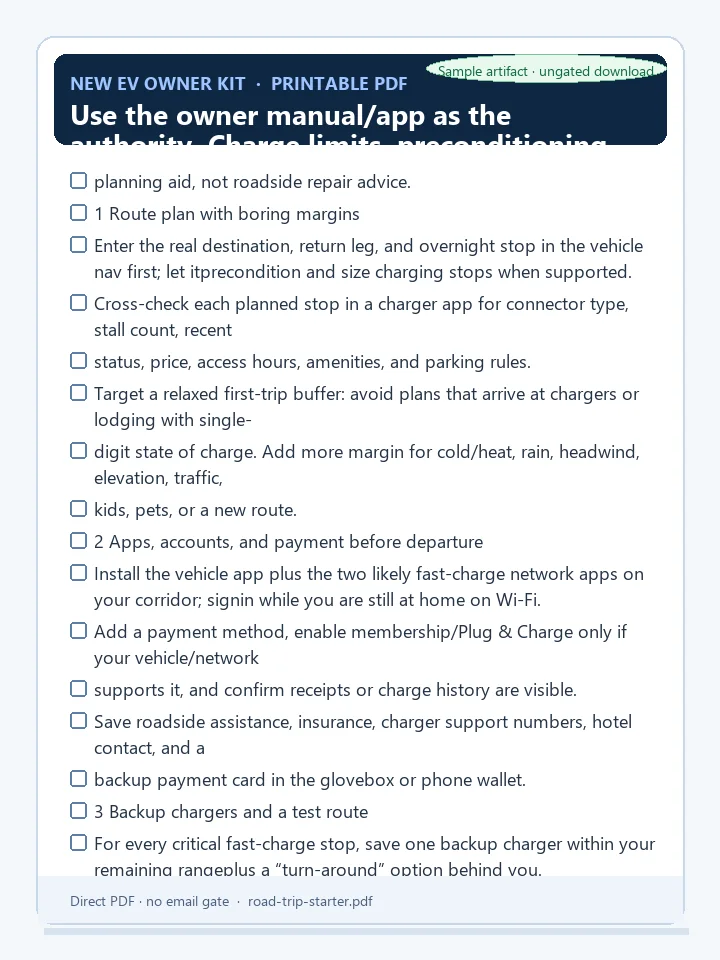
If you want a one-page pre-trip flow, download the road-trip charging starter PDF from the resources library.
Charger stop routine
At each charging stop:
- Park so the cable reaches without strain.
- Check the charger screen and app before unloading passengers.
- Start the session before walking away.
- Confirm the car is actually charging and note the departure target.
- Use the stop for bathrooms, trash, snacks, pet breaks, or stretching.
- Repack cable, wipes, trash, and snacks before the car is ready to leave.
If a charger seems slow, damaged, blocked, or confusing, move early instead of waiting until frustration builds.
Minimal packing list
Use this compact version for a normal highway weekend:
- Tire inflator.
- Tire-pressure gauge.
- Phone cables and charged power bank.
- First-aid kit, flashlight, reflective visibility item, and gloves.
- Microfiber towels, screen cloth, wipes, and small towel.
- Trash bags.
- Soft cable/adaptor bin.
- Water, snacks, and a small cooler or lunch bag if needed.
- One weather-specific item set, not every season’s gear.
- Backup charger saved in navigation and charging apps logged in.
If the list no longer fits in one small bin plus a snack bag, remove the items that do not match this route.
Common mistakes
Mistake: carrying too many emergency items and no tire solution
The most common road-trip friction is boring: low tire pressure, messy cabin, phone battery drain, and charger uncertainty. Start there.
Mistake: buying a powered cooler before knowing your trip pattern
A small soft cooler handles most first trips. Upgrade only if food, medication, kids, pets, or repeated long-distance routines prove the need.
Mistake: planning every stop at a very low arrival percentage
A tight plan may be efficient on paper but stressful with weather, traffic, busy chargers, passengers, pets, or detours.
Mistake: assuming hotel chargers will be available
Call or message the property if overnight charging matters. Ask whether chargers are working, reserved, shared, free, paid, or valet-controlled.
Mistake: leaving the kit in permanent expansion mode
After each trip, remove what you did not use or almost need. The best EV road-trip kit stays small enough that you keep it in the car.
Related guides
Review charging basics, the range anxiety reality check, and the charger apps directory before the trip, use the tire inflator and pressure gauge guide for pressure gear, compare against the EV emergency kit checklist, and keep the kit lean with accessories to skip. If your trunk gets messy, use storage and organization.